
The vertical light plane is ambient light that originates from a wall-height vertical surface – most often the window – instead of from overhead ceiling fixtures. It is a way of describing where a room’s ambient light comes from. For most of the last century, that answer has been the ceiling. The vertical light plane changes the origin.
Definition: In interior lighting design, the vertical light plane is ambient illumination that emanates from a wall-height vertical surface – such as a window or wall – rather than from the ceiling. Light enters the room laterally, across the field of vision, the same way daylight does through a window.
It is a concept, not a fixture. You can pursue a vertical light plane with wall washers, cove details, or backlit panels. But until recently there was no way to create one from the window itself, the one vertical surface in nearly every room that already manages daylight, privacy, and the view. That is the gap LiteLüvr was built to close.
For centuries, ambient light in architecture has come from above – candles on ceilings, gas fixtures, electrical recessed cans. The vertical light plane changes the origin. It positions light at the window wall, where daylight already lives, emitting from the same architectural surface that manages privacy and frames the view. LiteLüvr® by Radiant Blinds is the first product built around this principle.
Where the term comes from
Lighting designers have long distinguished between horizontal and vertical illuminance – light measured on a flat surface like a desk versus light measured on a wall. Vertical illuminance has been understood in museum, gallery, and architectural practice for decades, because it governs how bright and how spacious a room actually feels to the people standing in it.
What is new is bringing that idea into residential and hospitality design under a single, usable name: the vertical light plane. It describes not just a measurement but a design intention – to treat a vertical surface as the room’s primary ambient source rather than a place where ceiling light happens to land.
Why light from the wall reads brighter
The human visual system does not weight every surface equally. We spend most of our waking hours looking ahead, not up or down, so the walls in our field of view do more to shape our sense of a room’s brightness than the floor or ceiling.
- ~80% – Of visual information from the horizontal view
- 3-5x – Perceived brightness walls vs. floors at equal lux
- 6-8 – Ceiling penetrations in a typical 12×12 room
Lighting research has consistently shown that illuminating vertical surfaces produces a markedly higher impression of brightness than illuminating the floor at the same measured light level. The room does not contain more light. The light is simply placed where the eye is already looking. This is why a space lit from the wall plane can feel calm and full at a fraction of the fixture count a ceiling-first scheme would require.
It is also why a dark room rarely needs more ceiling fixtures to feel brighter. For practical fixes that work without a remodel, see how to brighten a dark room without major remodeling.
The residential problem
Recessed downlights became the default residential solution for practical reasons: ceilings are easy to access, easy to wire, and easy to lay out on a grid. The result is functional but predictable: hard shadows under faces, flat illumination on the walls, and a quality of light that can read more like an office than a home.
The traditional way to add a vertical layer only deepened the problem. Wall washers, asymmetric downlights, and linear slots all live on the ceiling. To move light off the ceiling, you had to add more to the ceiling.
The designer’s paradox
To create a vertical light plane the conventional way, you traditionally needed more fixtures on the ceiling; wall washers and asymmetric downlights that still require ceiling access, wiring, and housing. The ambient layer you were trying to lift off the ceiling still originated from above.
What makes a true vertical light plane
Not every glowing surface qualifies. A true vertical light plane has three characteristics:
- Origin at the wall, not the ceiling. The light emanates from a vertical surface in the field of view.
- Ambient, not accent. It distributes evenly across the surface to light the room; it is not a bright edge, a strip, or a single point.
- Diffused, not direct. The output is softened so there are no hotspots and no glare, producing an even wash rather than a visible source.
How LiteLüvr creates one from the window
LiteLüvr is a window-integrated lighting shutter system that turns plantation-style louvers into a controllable ambient light source while still functioning as a full privacy treatment. LED arrays are integrated into each 3.5-inch medical-grade polycarbonate louver and passed through a dedicated diffusion layer, so the underside of each louver casts a soft, candlelight-warm glow into the room.
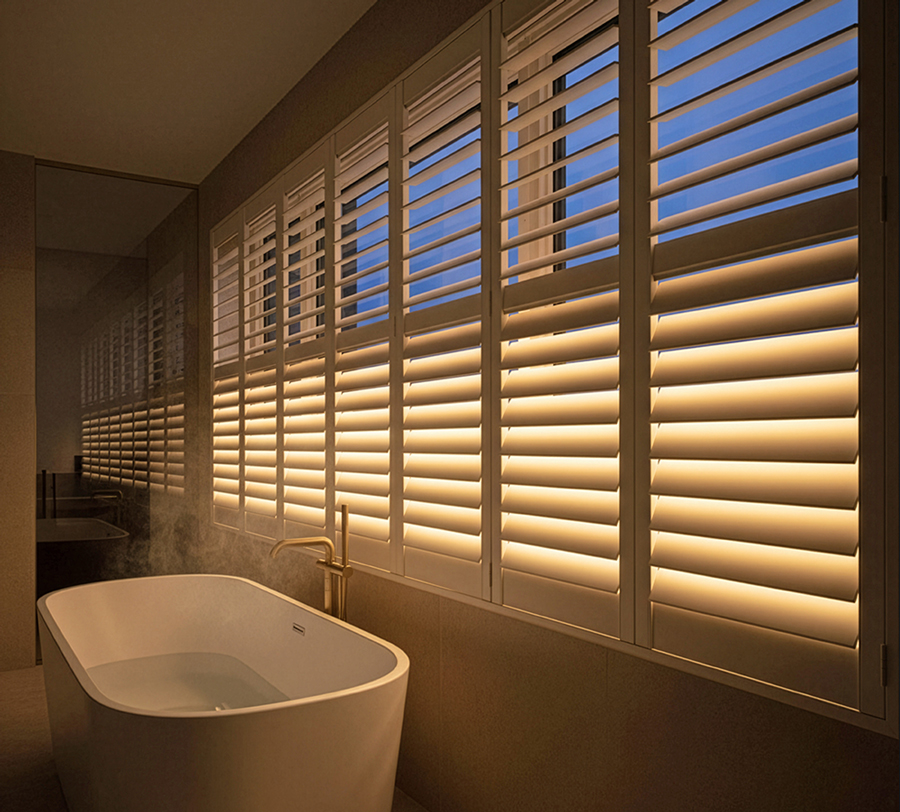
By day, the panels work like beautiful shutters. After sunset, when the window is usually the darkest surface in the room, the louvers come up as a warm, even field of light. Output options include warm white (~3200K) and bright white (~4000K), fully dimmable, and controlled by touch on the shutter surface or through the iOS and Android app, including sunrise and sunset simulation. The window stops being a dark rectangle and becomes part of the room’s lighting plan.
See it live: See how LiteLüvr creates the Vertical Light Plane — the product page on liteluvr.com, with day and night imagery, the three-layer mechanism, and the color options.
LiteLüvr is one type of window-integrated lighting; see what window-integrated lighting is for the wider category.
What the vertical light plane is not
Because the term is new in residential design, it is worth being precise about what does not count:
- It is not a backlit blind. A backlit shade glows behind fabric as an accent. The vertical light plane is a primary ambient layer.
- It is not an LED strip. A strip reads as an applied edge of light. LiteLüvr emits a diffused glow from the louver field, not a visible line.
- It is not a lamp. A lamp adds another object to the room. The vertical light plane comes from a surface that is already there.
- It is not a replacement for all lighting. The Vertical Light Plane can become a room’s ambient foundation, reducing reliance on ceiling-based ambient lighting while leaving task, accent and decorative layers free to do their jobs.
Vertical light plane vs. ceiling-first lighting
| Ceiling-First Scheme | Vertical Light Plane with LiteLüvr |
|---|---|
| Light projects down onto horizontal surfaces | Light enters laterally from the window wall |
| 6-8 recessed cans per room, plus wall washers for any vertical layer | Ambient layer from the shutter, no additional fixtures |
| Multiple ceiling penetrations and wiring runs | One low-voltage cord per panel, no ceiling penetrations |
| Shadows under faces, flat walls | Faces softened, walls bright, even field |
| Room feels lit from above | Room feels lit from within |
Frequently asked questions
What is the vertical light plane in simple terms?
It is ambient light that comes from a wall-height surface, usually the window, instead of from the ceiling. It changes the origin of a room’s light from above to the side, where daylight already enters.
How is it different from recessed or ceiling lighting?
Recessed lighting projects down onto horizontal surfaces. The vertical light plane illuminates the wall field itself, which the eye reads as significantly brighter at the same light level because walls sit in our natural field of view.
What product creates a vertical light plane at the window?
LiteLüvr, by Radiant Blinds, LLC, is a window-integrated lighting shutter system that turns plantation-style louvers into a controllable ambient light source. It is the first product built specifically to create a vertical light plane from the window itself, with no ceiling fixtures required.
Is it the same as a backlit blind or LED strip?
No. A backlit blind or LED strip is an applied accent that glows at an edge or behind a panel. LiteLüvr integrates LED arrays into each louver and diffuses them, so the shutter field emits an even, shadow-free glow into the room rather than a visible strip of light.
Related guides
- How to add ambient lighting without ceiling fixtures
- Window treatments that produce their own light
- The newest innovation in luxury window coverings
- What to do with a window that has an ugly view
LiteLüvr® is a window-integrated lighting shutter system by Radiant Blinds, LLC. To see the vertical light plane in a real residential setting, request a showing.