
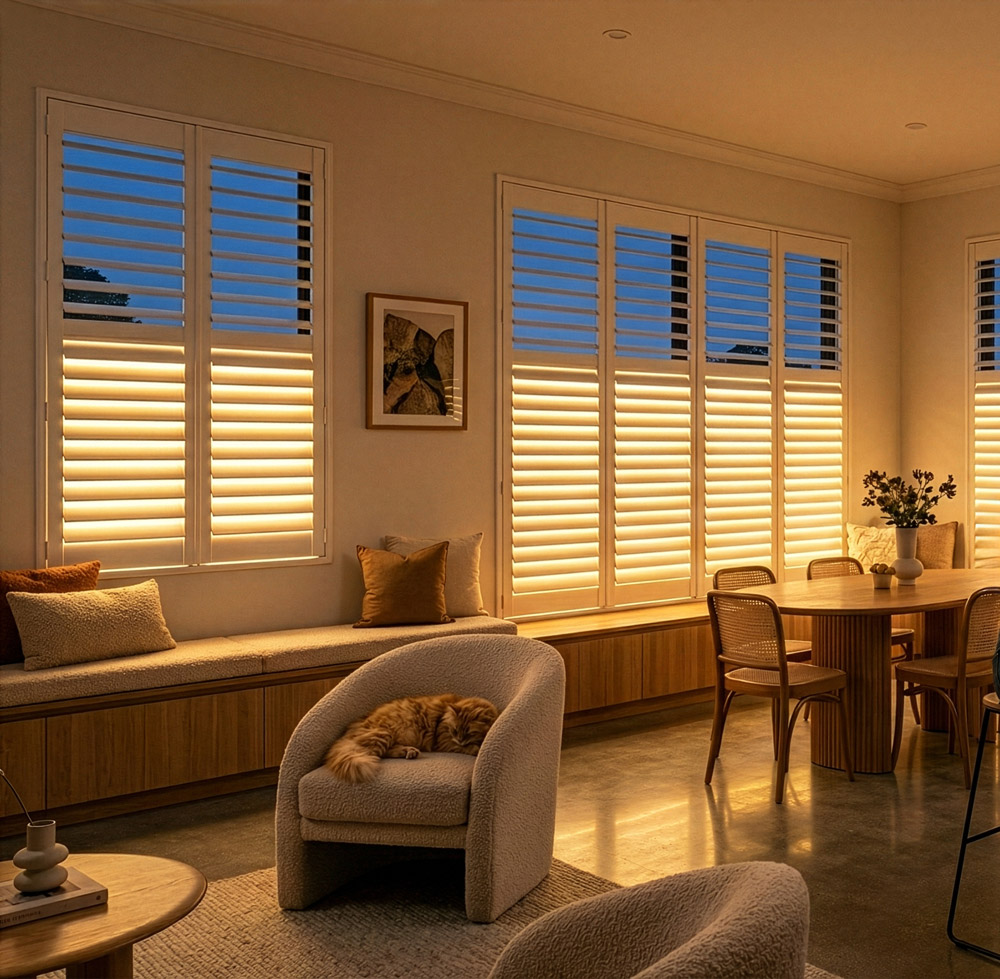
Recessed cans became the default residential light because they are easy to lay out on a grid, not because they make rooms feel good. If you are planning a remodel, lighting a room that has no overhead fixture, or simply tired of the glare and the dotted ceiling, there are better ways to light a room. Most of them require no ceiling work at all.
The strongest alternatives to recessed and overhead lighting are wall sconces, floor and table lamps, cove and indirect lighting, picture and art lights, surface-mounted track, under-cabinet and shelf lighting, plug-in and rechargeable fixtures, and window-integrated lighting. The best rooms combine two or three of them: one source for ambient light, one for tasks, one for accent. For the ambient layer, light from the walls and the window reads warmer and brighter to the eye than the same light aimed down from the ceiling.
Why people are moving away from can lights
Recessed lighting solves one problem well: it puts a lot of light on the floor with very little visible hardware. The trouble is that the floor is not where the eye looks.
The alternatives below all share one idea: put light on the vertical surfaces people actually see, and let the ceiling go quiet. That idea has a name in lighting design, the vertical light plane.
The alternativesEight alternatives to recessed and overhead lighting
Each one tagged by the lighting layer it serves best, so you can combine them into a complete room.
Wall sconces
Sconces put light where the eye actually looks, on the wall, and they soften faces instead of shadowing them. Hardwired sconces need a wall junction box; plug-in and rechargeable versions need only a mounting screw.
Best forLiving rooms, bedrooms, hallways, flanking a bed or sofa
Floor and table lamps
The oldest alternative is still one of the best. Three or four lamps at different heights will make a room feel warmer and fuller than a single ceiling fixture. Use shaded lamps for glow and directional lamps for reading.
Best forLiving rooms, bedrooms, rentals
Cove and indirect lighting
LED tape hidden in a cove, on top of cabinetry, or behind a valance bounces light off a wall or ceiling surface, so the room fills with soft light and no visible source. Calm and architectural, but usually part of a remodel since the detail has to be built.
Best forLiving rooms, bedrooms, kitchens with upper cabinets
Picture and art lights
A picture light or small adjustable accent light turns a wall into a lit surface. It is accent light rather than ambient, but lit art and lit walls make the whole room read brighter at very low wattage.
Best forArt walls, bookshelves, dining rooms
Surface-mounted track and monorail
Track mounts to the ceiling surface from a single junction box, so there is one connection instead of a grid of holes. Heads aim where you want them. It is still an overhead source, so aim it at walls and art rather than the floor.
Best forKitchens, galleries, lofts, rooms with one existing ceiling box
Under-cabinet and shelf lighting
Task light belongs close to the task. Under-cabinet LED bars light counters without the shadow your own body casts under a ceiling light, and shelf lighting turns built-ins into a softly glowing wall. Many options are plug-in or low-voltage.
Best forKitchens, home offices, bookshelves
Plug-in and rechargeable fixtures
Rechargeable table lamps, plug-in sconces with cord covers, and adhesive LED fixtures have made no-wiring lighting genuinely attractive. Ideal for renters, historic homes, and anyone testing a layout before committing to wiring.
Best forRentals, historic homes, quick upgrades
Window-integrated lighting
The window is the one vertical surface nearly every room already has. Window-integrated lighting builds the light source into the window treatment itself, so after dark the window becomes an ambient source instead of a dark rectangle. LiteLüvr illuminated shutters are the most direct example.
Best forBedrooms, living rooms, any room that goes dim at night
How the alternatives compare
The column that matters most for a retrofit is ceiling work. Six of the eight need none.
| Alternative | Lighting layer | Ceiling work | Retrofit friendly |
|---|---|---|---|
| Wall sconces | Ambient, accent | None | Yes (plug-in); wall box for hardwired |
| Floor and table lamps | Ambient, task | None | Yes |
| Cove and indirect | Ambient | None, but a built detail | Usually part of a remodel |
| Picture and art lights | Accent | None | Yes |
| Surface-mounted track | Accent, task | One junction box | Yes, with an existing box |
| Under-cabinet and shelf | Task, accent | None | Yes |
| Plug-in and rechargeable | All three | None | Yes |
| Window-integrated lighting | Ambient | None | Yes, installs like a shutter |
Which alternative fits your room
- Renting, or cannot touch the wiring. Lamps, plug-in sconces, and rechargeable fixtures. Everything leaves with you.
- Plaster, concrete, or a ceiling you do not want to cut. Sconces, track from an existing box, and window-integrated lighting.
- The room feels like a cave even with cans. Move light to the walls: sconces, wall-washing track heads, or cove lighting.
- The room goes dark after sunset. The bare window is usually the largest dark surface in the room. See how to brighten a dark room without major remodeling.
- Kitchen. Under-cabinet light for tasks, pendants or track over the island, and a soft ambient layer that is not a grid of cans.
- You want light with no visible fixtures. Cove, shelf lighting, and the window plane. See how to add ambient lighting without ceiling fixtures.
The ambient layer, moved to the window
LiteLüvr®, by Radiant Blinds, LLC, is a window-integrated lighting shutter system. LED arrays are built into each 3.5-inch louver behind a diffusion layer, so after dark the shutter becomes an even, glowing ambient source at the window plane. By day it is a full plantation shutter and privacy treatment.
It installs like a standard plantation shutter with one low-voltage cord per panel, so it adds an ambient layer without cutting the ceiling. Light is warm white (~3200K) or bright white (~4000K), chosen at the time of order, fully dimmable, and controlled by touch on the shutter stile or through the iOS and Android app.
LiteLüvr is designed to take over the ambient job that cans usually do, not every light in the room. Lamps, sconces, and task lighting still do their work.
For a shorter, product-side take, see LiteLüvr's guide to alternatives to recessed lighting.
Common mistakes when replacing recessed lighting
- Replacing a grid of cans with a grid of something else. The problem was never the fixture shape. It was lighting the floor instead of the walls.
- Relying on one source. Any single fixture, overhead or not, leaves shadows and dark corners. Layer at least two.
- Mixing color temperatures. Very different color temperatures in one room read as chaotic. Keep the sources in a room within a similar range.
- Skipping dimming. The best alternatives dim, so the same room can be bright at dinner and quiet at night.
- Forgetting the window. After dark, a bare window is the largest dark surface in most rooms, and no amount of ceiling light fixes that.
Frequently asked questions
Are recessed lights outdated?
Not outdated, but no longer the automatic default. Many designers now use fewer cans, or none, and build rooms from wall, lamp, cove, and window light instead, because light on vertical surfaces makes a room feel brighter and more flattering than a grid of downlights.
What can I use instead of recessed lighting?
Wall sconces, floor and table lamps, cove and indirect lighting, picture and art lights, surface-mounted track, under-cabinet and shelf lighting, plug-in and rechargeable fixtures, and window-integrated lighting. Combine two or three to cover ambient, task, and accent light.
How do I light a room with no overhead lighting?
Layer lamps at different heights, add wall sconces (plug-in if you cannot wire), light art or shelves for accent, and give the room an ambient source that is not on the ceiling, such as cove lighting or window-integrated lighting.
What is the best alternative to recessed lights for ambient light?
Sources that light vertical surfaces: wall sconces, cove lighting, and window-integrated lighting. The eye reads a lit wall as a brighter room than a lit floor at the same measured light level.
Can I add ambient light without cutting into the ceiling?
Yes. Lamps, plug-in sconces, and window-integrated lighting all add ambient light with no ceiling work. LiteLüvr illuminated shutters install like a standard plantation shutter with one low-voltage cord per panel.
Is track lighting better than recessed lighting?
Track needs one ceiling connection instead of a grid of holes, and its heads can be aimed at walls and art, where light does the most good. It is still an overhead source, so it works best as accent and wall-washing light alongside other layers.
Ready to take the ambient layer off the ceiling? LiteLüvr® turns the window into a soft, dimmable light source after dark, with no ceiling work.
Book a consultation