
A dark room is not always a light problem. Sometimes it is a reflectance problem, a temperature problem, or a source-placement problem. Before you knock out a wall or add recessed cans to the ceiling, work through the eight approaches below that solve most dark-room complaints without pulling permits.
Most dark rooms improve dramatically with a combination of three or four levers: repainting walls in a warm reflective color, placing a large mirror opposite the light source, trading dark textiles for lighter ones, layering lighting so it comes from multiple heights, matching bulb color temperature and lumens to the room, adding wall sconces or up-lights, reworking window treatments, and bringing light to the window plane itself with window-integrated lighting. Start with paint and layered lighting. Almost no room needs all eight.
Why rooms feel dark
Rooms feel dark for four common reasons, and most rooms have more than one:
Identifying which of these apply to your room narrows the fix considerably. A dark north-facing bedroom with white walls is a different project than a well-oriented living room that only feels dim after sunset.
The eight approachesEight ways to brighten a dark room
Ordered roughly from easiest and cheapest to more involved. Read them as a menu, not a checklist.
Repaint in a warm, reflective palette
Paint has the highest ratio of impact to effort of anything on this list. A wall with 80% light reflectance value (LRV, printed on the paint chip) puts nearly twice as much light back into the room as one with 45%. Warm off-whites, soft neutrals, and pale ochres read brighter than pure white, which can go clinical under electric light. Paint the ceiling a shade paler than the walls so it feels taller.
Place mirrors opposite the light source
A mirror hung directly opposite a window effectively doubles the daylight entering the room. A mirror across from a lamp does the same for artificial light. Aim for one large mirror rather than a gallery of small ones. A single reflective surface reads as another window; a collection reads as decoration and does less lighting work.
Trade dark textiles for lighter ones
Rugs, drapery, and upholstery matter more than most people think. A large dark rug absorbs a startling amount of light. Consider a paler area rug, sheer or off-white drapery, and lighter upholstery on the biggest pieces. You do not need to redecorate. Swap one or two of the largest textile surfaces and reassess.
Layer your lighting
Most dark-room complaints trace back to a single overhead fixture doing all the work. A properly lit room uses three layers: ambient (fills the room), task (specific work like reading), and accent (highlights art or architecture). Adding a table lamp and a floor lamp to a room that only has overhead lighting almost always makes it feel brighter, without adding fixtures to the ceiling.
Match bulb color temperature and lumens
Bulbs are labeled with lumens (brightness) and color temperature in Kelvin (warmth). Living areas want 2700K to 3000K, which reads warm and inviting. Kitchens and offices tolerate 3500K to 4000K. Above 5000K reads clinical and is usually wrong at home. Aim for 800 to 1600 lumens per fixture in most rooms. Wrong color temperature is a common cause of a room that has enough lumens but still feels dim.
Add wall sconces or up-lights
Wall-mounted fixtures put light where the eye actually looks, at the wall, rather than aiming it down at the floor. A pair of sconces flanking a bed or sofa, a picture light over art, or up-lights aimed at a corner can transform a room without pulling wire into the ceiling. Battery-powered and plug-in versions remove the need for an electrician entirely.
Rework your window treatments
Heavy blackout drapes, dark blinds, and closed shutters cost you daylight even when you want it. Consider top-down bottom-up shades that keep privacy at the bottom while admitting light at the top, sheer layers under drapery, or shutters you can angle to admit diffused light while still screening a view. If the view is a wall, an alley, or a neighbor, see lighting solutions for windows with bad views for that specific case.
Bring light to the window plane itself
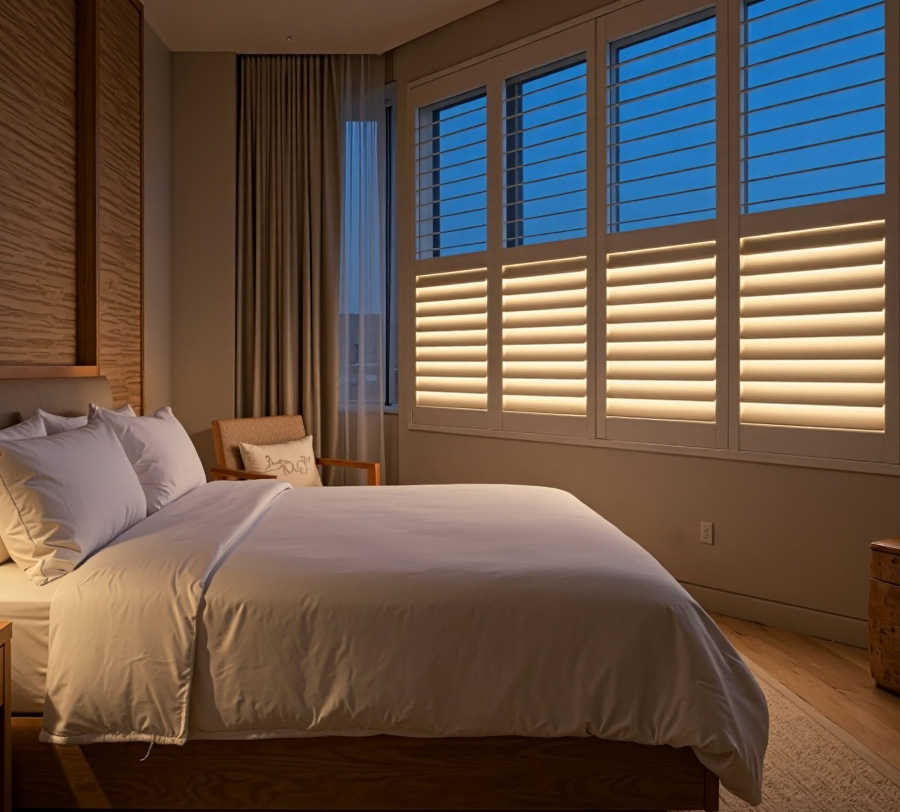
This is the least obvious method and the one that solves nighttime darkness the other methods miss. Window-integrated lighting, LEDs built into the window treatment itself, turns the window from the darkest surface in the room after sunset into a soft, warm ambient light source. LiteLüvr illuminated shutters are the most direct example: full plantation shutters by day, an even glow from the louver field after dark.
Which approach fits your situation
- Small budget, biggest impact. Paint, a large mirror, and a bulb swap. Under $400 in most rooms.
- Feels dim only at night. Add wall sconces, up-lights, or window-integrated lighting at the window plane. Daytime methods will not solve a nighttime problem.
- Dark heavy furniture that cannot leave. Rethink textiles, add reflective surfaces, and layer lighting so it is not fighting the furniture alone.
- Bad view forcing closed coverings. See lighting solutions for windows with bad views. Screen the view, keep the daylight, bring the window alive at night.
- Ceiling cannot take more fixtures. See ambient lighting without ceiling fixtures. Use wall sources or the window plane instead.
- Feels flat even when technically bright. The issue is source placement, not source count. Layer, do not amplify.
Common mistakes to avoid
- Adding one very bright bulb. A single high-lumen source creates hotspots and hard shadows. Several moderate sources almost always beat one intense one.
- Ignoring color temperature. A room lit with 5000K daylight bulbs will feel institutional and dim to the eye at any lumens.
- Adding more recessed cans without addressing walls. Downlights land on the floor. Wall brightness is what your eye reads as room brightness.
- Painting everything pure white. Pure white can turn cold and flat under electric light. A warm off-white almost always feels brighter and more inviting.
- Assuming brighter always means better. Well-placed moderate light usually beats over-lit compensation.
Frequently asked questions
How do I brighten a dark room without adding recessed lighting?
Combine paint (walls with 70% or higher LRV), a large mirror opposite the window, layered lighting from wall sconces and lamps, and window-integrated lighting for after-dark ambience. Most dark rooms improve dramatically without any ceiling work at all. See ambient lighting without ceiling fixtures for the full playbook.
What color paint makes a dark room look brighter?
Warm off-whites, pale ochres, soft neutrals, and pale warm greys with a light reflectance value (LRV) of 70% or higher. Avoid pure white, which can read cold under electric light. Paint chips list LRV alongside the color name.
Do LED bulbs actually make a room feel brighter?
Yes, if the lumens and color temperature are right for the room. Living areas should use 2700K to 3000K bulbs; kitchens 3500K to 4000K; task lighting can go higher. Aim for 800 to 1600 lumens per fixture in most rooms.
Why does my room still feel dark at night even with plenty of lamps?
The window is usually the culprit. After sunset, a bare window becomes the darkest surface in the room and creates a large dead area that pulls down the visual brightness of the whole space. Window-integrated lighting, LEDs built into the shutter or shade itself, keeps the window contributing light after dark instead of consuming it.
Do mirrors really help brighten a room?
Yes, when placed opposite a light source. A mirror across from a window effectively doubles the daylight entering the room. A mirror across from a lamp does the same for artificial light. One large mirror reads as another window; small groupings read as decoration and do less lighting work.
Is it worth painting the ceiling to brighten a room?
Yes. A ceiling painted slightly lighter than the walls makes a room feel taller and reflects more light back down. Pure white can work but a warm off-white ceiling with 80% or higher LRV usually feels better and more inviting.
If your room stays dim after the daytime fixes, the issue is often the window itself going dark at sunset. LiteLüvr® turns the window into a warm ambient light source after dark, without any ceiling work.
Book a consultation